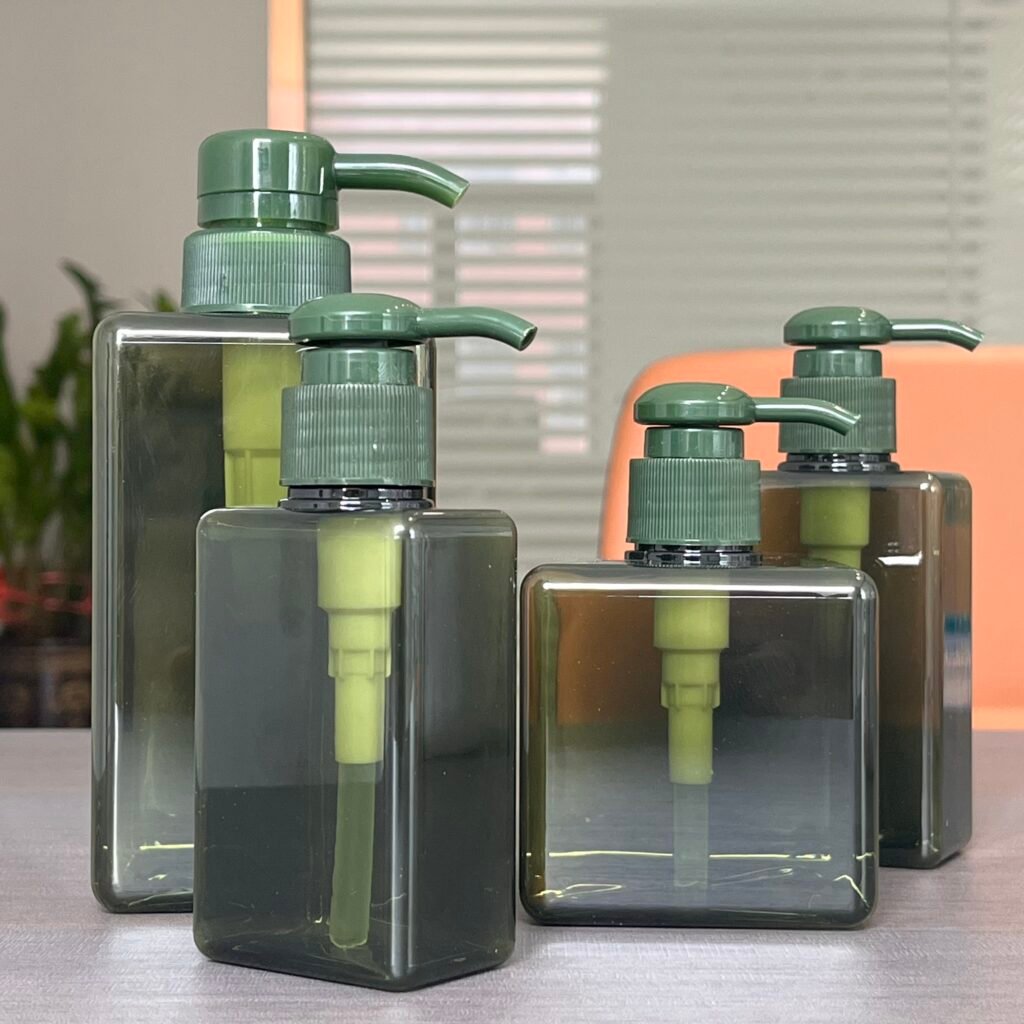
The production of polyethylene terephthalate (PET) blow-molded bottles can be classified into injection stretch blow molding (ISBM, also known as injection stretch blow molding) and extrusion stretch blow molding (ESBM, also known as extrusion stretch blow molding) based on the pre-forming of the preform. Among these two molding methods, ISBM is more commonly used due to its easy control, high production efficiency and low rate of defective products.
The production of polyethylene terephthalate (PET) blow-molded bottles can be classified into injection stretch blow molding (abbreviated as injection blow molding) and extrusion stretch blow molding (referred to as extrusion blow molding) based on different preforms. Among these two molding methods, the injection blow molding process is easy to control, has high production efficiency, and generates less waste.
PET blow-molded bottles can be divided into two categories: pressure bottles, such as those containing carbonated beverages; and non-pressure bottles, such as those filled with water. Tea beverage bottles made of modified PET, which is a blend of polyethylene naphthalate (PEN) or PET and thermoplastic polyarylate, are classified as hot bottles and can withstand temperatures up to 80°C or higher. Cold bottles do not require heat resistance. The hot bottle is similar to the cold bottle in the molding process.
The following mainly discusses the molding process of pressurized beverage bottles in cold bottles.
Equipment
With continuous technological advancements and the expansion of production scale, PET blow molding machines have become increasingly automated, with higher production efficiency. The production capacity of the equipment has continuously improved, from several thousand bottles per hour in the past to tens of thousands of bottles per hour currently. The operation has also evolved from the previous manual button type to the current fully computer-controlled type, which significantly reduces the difficulty of process operation and enhances process stability.
Currently, the main manufacturers of injection molding equipment include the French company SIDEL and the German company KRONES. Although the manufacturers are different, the equipment principles are similar, generally consisting of five parts: blank system, heating system, blow molding system, control system, and auxiliary machines.
Blow molding process
PET bottle blow molding process. The important factors affecting the PET bottle blowing process are preform heating, pre-blowing mold and environment.
Preform: When preparing blow-molded bottles, PET chips are first injection molded into preforms. The proportion of secondary recycled materials should not be too high (less than 5%), the number of recycling should not exceed 2, and the molecular weight and viscosity should not be too low (molecular weight of 31,000-50,000, intrinsic viscosity of 0.78-0.85 cm3/g). The injection molded preforms can be stored for 48 hours or longer. Unused preforms after heating must be stored for another 48 hours before reheating. Preforms should not be stored for more than six months. The quality of the preforms largely depends on the quality of the PET material. Materials that are easy to expand can be selected and a reasonable preform molding process can be established.
Experiments show that preforms made from PET materials of the same viscosity are easier to blow than those made from domestic materials; although the preforms of the same batch have different production dates, the blowing process may also vary greatly. The quality of the preforms determines the difficulty of the blowing process. The requirements for the preforms are purity, transparency, no impurities, no color spots, and appropriate length and peripheral halo.
Heating: The heating of the preforms is completed by the heating furnace, and the temperature of the heating furnace can be manually set and automatically adjusted. In the oven, far-infrared tubes emit far-infrared rays to radiate heat to the preforms, and the fan at the bottom of the oven performs heat circulation to make the temperature in the oven uniform. The preforms rotate while moving forward in the oven, so that the walls of the preforms are heated evenly. The arrangement of the lamps in the oven is usually “zone”. From top to bottom, more at the ends and less in the middle. The heat of the oven is controlled by the number of lamps turned on. The total temperature is set by the oven power and the heating ratio of each part together. The opening of the lamps should be adjusted together with the pre-blowing bottle.
To make the oven work better, it is very important to adjust the height of the cooling plate. If not adjusted properly, defects such as large bottle mouth (bottle mouth expansion) and hard neck (neck cannot be opened) are likely to occur during blowing.
Pre-blowing: Pre-blowing is a very important step in the two-step blowing method. It refers to the pre-blowing of the preform when the stretching rod descends during the blowing process, so that the preform has a shape. The pre-blowing position, pre-blowing pressure and blowing flow rate are three important process factors in this process. The advantages and disadvantages of the pre-blowing bottle shape determine the difficulty of the blowing process and the performance of the bottle. The normal pre-blowing bottle shape is spindle-shaped, and the abnormal shape is bell-shaped or handle-shaped, as shown in Figure 2. The reason for the abnormal shape is improper local heating, insufficient pre-blowing pressure or blowing flow rate, and the size of the pre-blowing bottle depends on the pre-blowing pressure and pre-blowing position. In production, the size and shape of all pre-blowing bottles of the entire equipment must be the same. If there are differences, the specific reasons must be found, and the heating or pre-blowing process can be adjusted according to the pre-blowing conditions. The pre-blowing pressure varies with the size of the bottle. Generally, the larger the capacity, the smaller the pre-blowing pressure; the higher the production capacity of the equipment, the higher the pre-blowing pressure.
Even if bottles of the same specification are produced by the same equipment, the required pre-blowing pressure is different due to the performance differences of PET materials. For glass fiber reinforced PET materials, a small pre-blowing pressure can make the high molecular weight at the bottom of the bottle correctly oriented; for other incorrect or incorrectly shaped preforms, a large amount of stress concentration near the injection point is not easy to dissipate, and if blow-molded, it often blows out or bursts from the injection point during pressure testing.
According to the orientation conditions, the lamps can be removed from 2-3 rods as shown above to open above the injection point, and this point is fully heated to provide sufficient heat to promote its orientation. For preforms that have been heated for secondary use or have exceeded the storage time, the molding process is similar due to the time-temperature difference effect. Compared with ordinary preforms, less heat is required and the pre-blowing pressure is also appropriately reduced.
Auxiliary machines and molds: Auxiliary machines mainly refer to the equipment that keeps the molds at a constant temperature. The constant temperature of the molds plays a significant role in maintaining product stability. Generally, the temperature at the top of the bottle is higher than that at the bottom. For cold bottles, since the cooling effect at the bottom determines the degree of molecular orientation, it is best to keep the temperature at 5-8℃; the bottom of hot bottles is much warmer. Molds are an important factor affecting the PET bottle blow molding process. The advantages and disadvantages of the mold shape will reduce or increase the difficulty of process adjustment. For example, ribs, the curvature of the transition area, and the heat dissipation at the bottom all have an impact on process adjustment.
Environment: The quality of the production environment also has a greater impact on process adjustment. Constant conditions can maintain process stability and product stability. PET bottle blow molding is usually preferred to be carried out at room temperature and low humidity.
Other requirements: Pressure bottles should meet the requirements of pressure testing and pressure resistance testing. Pressure testing is an internal quality control to prevent molecular chain cracking and leakage during the contact of the PET bottle bottom with lubricants (alkaline); pressure resistance testing is a quality control to prevent the bottle from exploding when filled with a certain pressure of gas.
To meet these two requirements, the thickness at the center point should be controlled within a certain range. Generally, a thinner center point is better for stress testing but has poorer voltage resistance; a thicker center point has better voltage resistance but poorer stress testing. Of course, the results of the pressure resistance test are also closely related to the material accumulation in the transition area around the center point, which is adjusted based on practical experience. Conclusion
Adjust the PET bottle blowing process for the corresponding materials. If the materials are not good, the requirements for the process are very strict, and it may even be very difficult to blow out qualified bottles.